Throughout the year, Agate NGO’s work has brought together advocacy, the empowerment of women and communities, and the strengthening of capacities of state and civil society actors, with one clear goal: achieving real and sustainable change in the lives of persons with disabilities.
“Agate” continued its active engagement in legislative and policy processes, putting forward reform proposals and advocating for the restoration and protection of the rights of persons with disabilities. Providing consultations on accessibility and reasonable accommodation remained an integral part of the organization’s day-to-day work.
One of the key advocacy initiatives of the year was the observation of 83 polling stations in the Gyumri community. As a result, “Agate” developed a map of accessible polling stations, conducted awareness-raising activities, and submitted recommendations to the Central Electoral Commission, contributing to more inclusive and accessible electoral processes.
The year was also marked by strong engagement at international platforms. “Agate” contributed to the policy brief developed by Kvinna till Kvinna titled “Disability Rights from a Gender and Women, Peace and Security Perspective in Eastern Europe and the South Caucasus”, presenting the Armenian context and placing particular emphasis on the lived experiences of women with disabilities.
Agate’s President, Karine Grigoryan, participated in the OSCE Human Dimension Conference 2025 in Warsaw, and spoke at a Kvinna till Kvinna–organized side event entitled “Invisible Voices: Disability Rights through the Lens of Women, Peace, and Security”․ This was the only discussion at the conference fully dedicated to the rights of women with disabilities. In her intervention, Karine Grigoryan highlighted the systemic invisibility of women with disabilities in peacebuilding and humanitarian processes, shared the voices of women with disabilities forcibly displaced from Nagorno-Karabakh, and called for inclusive humanitarian and recovery programs in which women with disabilities are identified, engaged, and involved from the very beginning.
In March, “Agate” participated in consultations with the UN CRPD Pre-Sessional Working Group, presenting key concerns regarding violations of the rights of women with disabilities in Armenia. These included the inaccessibility of gender-based violence prevention and response systems, serious gaps in access to sexual and reproductive health services, discriminatory attitudes within the healthcare system, economic exclusion, limited employment opportunities, shortcomings in mechanisms ensuring independent living, and the limited scope and applicability of personal assistance services. The Committee’s subsequently published List of Issues for Armenia reflected nearly all of the concerns raised by “Agate”.
“Agate” also took part in a regional consultation with members of the UN Committee on the Elimination of Discrimination against Women (CEDAW) in Istanbul, where it presented recommendations on addressing disability-based discrimination and gender stereotypes. These recommendations will be reflected in CEDAW General Recommendation No. 41 on gender stereotypes, which is expected to be adopted by the end of 2026.
Empowerment: When Opportunities Transform Lives
Throughout the year, Agate focused on the economic, social, and personal empowerment of women with disabilities. The organization employed a support person forcibly displaced from Nagorno-Karabakh, contributing both to social inclusion and to the strengthening of the organization’s internal capacity.
“Agate” continued its sewing and handicraft courses, as well as independent living training programs for women with intellectual disabilities. In total, 10 training programs were organized for women with and without disabilities. Five of these trainings were delivered by trained women as peer educators and focused on sexual and reproductive health and the prevention of violence. These sessions were held in 11 rural communities of Shirak region, reaching approximately 150 women with disabilities and female members of their families.
One of the year’s most inspiring stories is Lusya’s. Through her participation in Agate’s programs, she became empowered to the extent that she coordinated a youth project, taught photography, and organized two exhibitions dedicated to urban accessibility and the ethical representation of persons with disabilities.
After several years of interruption, the youth exchange program was also relaunched and implemented in Greece, creating new opportunities for learning, cooperation, and cross-cultural exchange.
Capacity Development: Changing Systems, Not Only Lives
“Agate” continued to work with a wide range of stakeholders, including public administration bodies, local self-government authorities, social service providers, media representatives, businesses, educational and healthcare institutions, and civil society organizations.
The organization’s monitoring specialist, Roza Avagyan, conducted monitoring of services provided to women with disabilities who have experienced violence, while Karine Grigoryan developed a practical guideline for service providers. A one-day training was organized for staff of support centers, and a two-day training was delivered for doctors on the right to sexual and reproductive health.
In cooperation with the European Network on Independent Living, “Agate” organized online technical support meetings for civil society organizations. In October, three international experts visited Armenia and held meetings at the National Assembly of the Republic of Armenia, the Office of the Human Rights Defender, and with sectoral civil society organizations. As a result of these technical discussions, the Ministry of Labour and Social Affairs initiated amendments to the regulation governing the provision of personal assistance services. The most significant change ensures that when a person with a disability travels abroad—regardless of the purpose of travel—the state continues to finance their personal assistance service.
Community, Culture, and New Beginnings
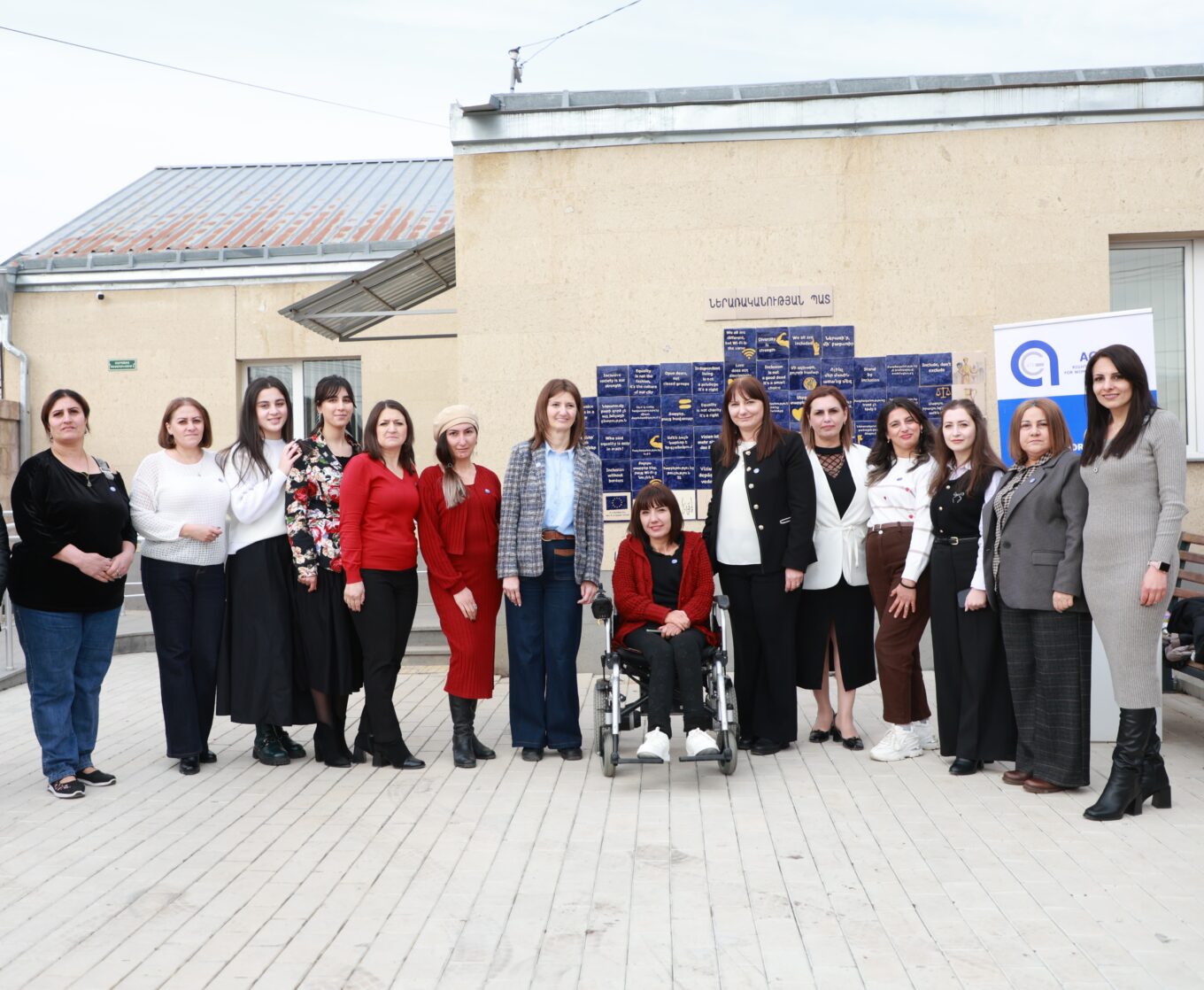
The year was also rich in public awareness and cultural initiatives. “Agate” organized a violence awareness action and created an inclusion wall in Gyumri as a public message promoting equality and diversity.
On December 3, the International Day of Persons with Disabilities, “Agate” organized an intellectual quiz based on the book “50 Women with Disabilities Who Changed the World.” The event brought together persons with disabilities and students from the Gyumri Technical College, fostering an inclusive and collaborative environment.
This year also marked the launch of the “Papa School” for the first time—an initiative aimed at promoting engaged fatherhood, care, and gender equality.
Looking Ahead
This year once again confirmed that meaningful change begins with people’s voices and is sustained through systemic solutions. “Agate” NGO will continue its work toward building an inclusive, just, and equal society—one in which women with disabilities are not merely beneficiaries, but active agents and drivers of change.