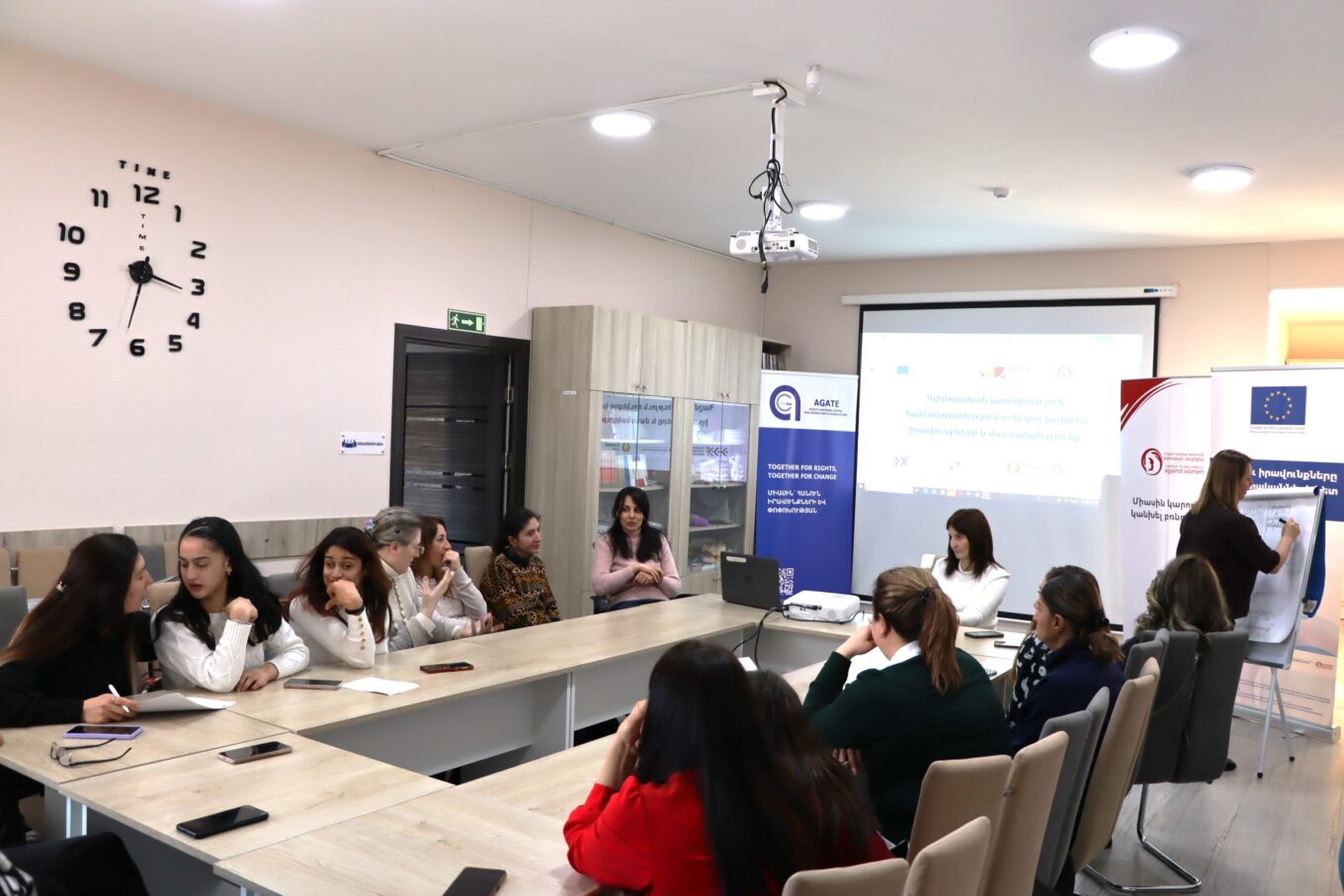
Within the framework of the European Union–funded project “Human Rights for and with Refugees,” the next meeting of the program activity “Creating Safe Spaces” was held on January 26, 2026. The meeting was organized by the “Agate” Rights Defense Center for Women With Disabilities NGO.
The meeting was conducted under the theme “Climate Justice: The Rights and Participation of Women with Disabilities” and aimed to enhance the psychological well-being, awareness, and participation in public life of persons with disabilities—particularly women—living in Shirak region, including those displaced from Nagorno-Karabakh.
The expert speaker of the meeting was Karine Grigoryan, President of the “Agate” NGO, who presented the fundamental concepts of climate change and climate justice. She addressed the root causes of the vulnerability of women with disabilities and emphasized the importance of recognizing their rights and ensuring their active participation in decision-making processes.
In her remarks, the expert particularly highlighted:
“Climate justice cannot be achieved if women with disabilities are excluded from information, services, and decision-making processes. Their voices must be heard at both local and national levels.”
During the discussion-based meeting, participants explored how climate change disproportionately affects vulnerable groups, especially women with disabilities. The discussions included practical examples from Armenia, such as water shortages, extreme summer heat, agricultural challenges, and barriers to accessing transportation, information, and healthcare services during emergency situations.
Special attention was given to the fact that gender inequality, disability-related barriers, poverty, and social isolation further intensify the impact of climate crises on the lives of women with disabilities. Issues related to accessibility of information were also discussed, including the lack of sign language interpretation, subtitles, and communication in plain language, which can result in delayed or complete lack of access to critical information about risks and emergencies.
During the training, participants became familiar with their rights under the UN Convention on the Rights of Persons with Disabilities (CRPD), particularly the rights to participation, safety, and access to information, with specific reference to Articles 11, 21, and 29 of the Convention.
As a result of the meeting, a high level of participant engagement, interest, and open and trusting discussion was observed. Participants noted that the meeting contributed to expanding their knowledge, recognizing their own rights, and understanding the importance of expressing their voices more confidently in public life.
The “Human Rights for and with Refugees” project is implemented with the support of the European Union by the Democracy Development Foundation, the Estonian Refugee Council, the Coalition to Stop Violence Against Women, and Commit Global. The project aims to support and empower refugees displaced from Nagorno-Karabakh by increasing their knowledge and awareness of their rights, addressing vulnerabilities, and ensuring access to clear and user-friendly information about available services and opportunities.